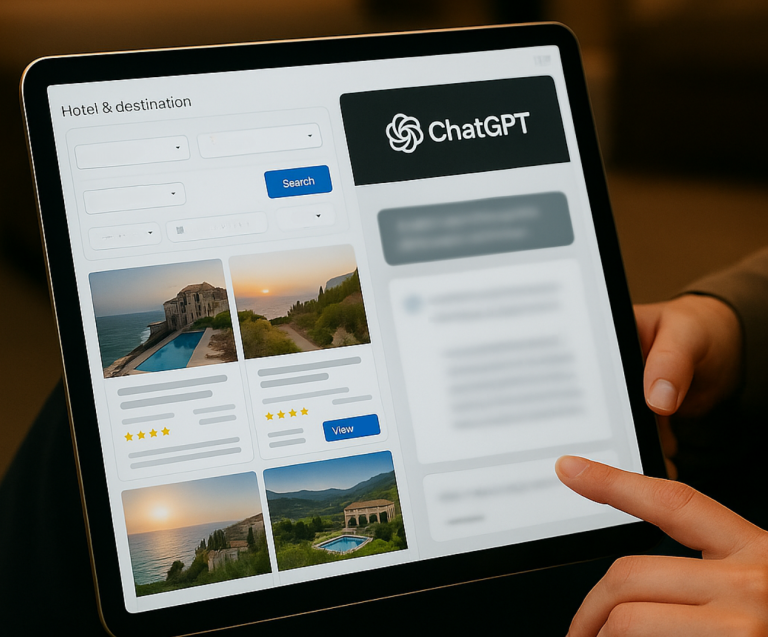
Zero-click search is rewriting the rules of SEO

I’ve worked in marketing for around fifteen years, the last seven of those focused purely on SEO. In that time I’ve watched Panda and Penguin rewrite what counted as good content, mobile-first indexing force a rethink of how whole sites got built, and the slow move away from matching keywords toward demonstrating genuine expertise and authority. Each one felt, at the time, like the biggest shift the industry had seen.
So when generative engine optimisation, or GEO, started coming up in nearly every conversation, I did what I usually do with a new trend: sat quietly and listened. Some people were clearly just trying to make a sale as fast as possible. Some described something that sounded suspiciously like SEO with a new name stuck on it. A handful went away and did proper research before saying anything at all.
Underneath all of it sat one fact nobody disputes: search traffic is declining. So is GEO the magic bullet some people would have you believe? I went looking for the data before deciding what I thought, and here’s what it says.
For most of the last two decades, SEO ran on one assumption: if you rank, you get the click. That assumption is breaking down, and the pace of the breakdown is the real story.
New research from SparkToro and Similarweb found that 68.01% of US Google searches ended without a click in the first four months of 2026, up from 60.45% in 2024. That’s the fastest two-year jump SparkToro has recorded since it started tracking this in 2019, when the figure stood at 49%. Some of that is Google’s own UI (maps, “People also ask”, knowledge panels), but the accelerant is AI Overviews, which now trigger on more than 20% of searches and cut click-through to the top-ranking organic result by around 58%, according to Ahrefs. A separate randomised field study found AI Overviews reduce organic clicks by 38% on the queries where they appear.
None of this means SEO stops working. It means the old scorecard (rank higher, get more clicks, get more traffic) no longer tells the whole story. Here’s what’s actually shifting underneath it.
Ranking #1 no longer means you’re the one being read
The more interesting change isn’t the CTR drop: it’s what’s happening to the link between ranking and citation. Ahrefs analysed 863,000 keywords and 4 million AI Overview URLs and found that only 38% of pages cited inside Google’s AI Overviews also rank in the top 10 organically for that query. Seven months earlier, that figure was 76%.
Some of that shift is down to better measurement on Ahrefs’ part, but a large part of it is Google’s “query fan-out”: when an AI Overview triggers, Google quietly splits the original search into several related sub-queries and pulls citations from wherever those sub-queries rank well, not just the page ranking for the exact term typed in. The upshot is that ranking top 10 and being cited in the answer are now two separate contests, running on overlapping but distinct rules. Optimising for one doesn’t guarantee the other any more.
Being mentioned isn’t the same as being visited
It’s tempting to treat GEO as a straight swap for the clicks AI Overviews are taking away: get cited by ChatGPT or Perplexity instead of ranking on Google. The funnel doesn’t work that cleanly, and there’s drop-off at every stage of it.
A brand mention doesn’t guarantee a citation. Ahrefs checked how often AI systems that mentioned “Ahrefs” in an answer actually linked back to the site as a source, and found it ranged from as low as 10% up to 51% at best, depending on the platform. Even a citation doesn’t guarantee a click: research into high-stakes purchase journeys by growth consultant Kevin Indig found 64% of AI Mode users clicked nothing at all. They got their answer and left, having effectively decided before they ever reached a website. And the traffic that does convert into a visit is still small in absolute terms: Ahrefs’ own tracking of 74,752 websites found all AI chatbots combined sent 3.5 million visits in March 2026, just 0.28% of total web traffic, against 30.53% still going to Google directly.
The genuinely good news in that funnel: the clicks that do arrive convert unusually well. Ahrefs found AI-referred visitors made up 0.5% of its own site traffic but 12.1% of signups, a 23x higher conversion rate than organic search, and a similar pattern has shown up elsewhere, including a reported 185% conversion uplift for LLM-driven traffic at Buffer. So this isn’t a channel with a poor payoff. It’s a channel converting very well on a volume too small, for now, to replace what organic search is losing.
The KPI has to move from clicks toward visibility
If a growing share of your audience sees your brand’s answer, price, or claim on the results page and never visits, a report built purely on organic sessions and CTR is missing a chunk of where the value landed. Rand Fishkin’s advice after SparkToro’s 2026 study is direct: stop using traffic as the primary KPI, and build a dashboard that correlates brand-visibility signals (branded search demand, direct traffic, share of voice in AI answers) against revenue, rather than relying on referral clicks as the only evidence a strategy is working.
That’s a genuine change in how success gets reported, not just measured. A drop in organic sessions next quarter might be evidence of a problem, or it might be evidence that a strategy is doing exactly what it’s meant to, just further up the funnel than a click.
Practical changes worth making now
In reporting, it helps to split what gets measured into two tracks. Transactional, branded, and local queries can still be reported the old way (sessions, conversions, revenue) because clicks there haven’t gone away. Informational queries need a different scorecard: ranking position still matters, but pair it with citation frequency (how often you show up inside AI Overviews and major LLM answers for priority terms) and share of voice against named competitors, since a fall in sessions on those terms may not mean a fall in performance. It’s also worth flagging to anyone reading the report that AI referral traffic under-reports itself: a meaningful share arrives without standard referrer data and gets misfiled as direct traffic, so any AI traffic figure you can show is a floor, not the full picture.
In strategy, the bulk of budget and effort should stay on the terms that still convert reliably: branded, local, transactional. For priority informational content, structure the direct answer to sit in the first few sentences. It doesn’t guarantee a citation, but content that isn’t structured for extraction has no chance of one. Beyond the page itself, it’s worth investing in what Ahrefs and others have found actually correlates with being mentioned by AI systems: genuine PR and media coverage, inclusion in independent “best of” and comparison lists, and a presence on the platforms that AI systems draw on heavily to gauge what real people think, Reddit and YouTube in particular. None of that is new advice; it’s the same reputation-building work that’s always mattered. It now just has a second audience: the models, not only the humans reading it directly.
Not all content takes the hit equally
The content losing out hardest is generic, already-commoditised informational content: plain “what is X” definitions, standard how-to steps, anything an AI Overview can lift and repackage without needing to send anyone anywhere. Original research, proprietary data, first-hand case studies, and anything that requires a visit to get the value (tools, calculators, quotes, bookings) are far less affected, because there’s nothing left to extract and answer instead.
Practically, that pushes content strategy away from restating what’s already indexed a thousand times over, and toward producing something an AI answer genuinely can’t summarise away.
Some categories barely feel it
It’s worth being precise about where this bites. Branded searches, local business queries, and high-intent transactional searches (“book a table at [restaurant]”, “plumber near me”) are still converting to clicks much as they always did, because people typing those terms want to land somewhere and do something. The queries losing clicks are overwhelmingly top-of-funnel, informational ones, where an instant answer genuinely satisfies what the searcher came for.
The oldest marketing channel there is
There’s a reason branded and local searches are holding up while generic informational content gets swallowed by AI answers. Someone discovering a business and having a good experience with it is arguably the oldest marketing channel there is, and it has never really stopped working.
In Pompeii, a fish sauce merchant called Aulus Umbricius Scaurus built what’s estimated to be close to a third of the entire garum market. He didn’t just sell a good product, he made sure everyone knew it was good: his amphorae came stamped with labels reading things like “Scaurus’s finest mackerel garum” and “best fish sauce,” and he commissioned a mosaic for his own house depicting four jars, each one labelled with a boast about the quality inside. Pliny the Elder wrote about how good Scaurus’s garum was. Nearly two thousand years later, we still know his name, because the product was genuinely excellent and he made sure that reputation travelled.
Go back further and the flip side of the same story exists too. Around 1750 BC, a Mesopotamian trader called Nanni wrote a clay tablet complaint to a copper merchant in Ur named Ea-nasir, over a delivery of copper he considered substandard and a servant he felt had been treated rudely. The tablet survived, and today it holds a Guinness World Record as the oldest known written customer complaint. Nobody remembers what Ea-nasir was good at. They remember that he shipped bad copper and handled a complaint badly, and that memory has outlasted his entire civilisation.
Genuine quality, genuine value, and a genuinely good customer experience, and their absence, have shaped which businesses get talked about for at least 3,800 years. AI Overviews and GEO haven’t changed that mechanism, they’ve just changed which platform the word of mouth happens on. A branded search converts well because someone already trusts the name before they type it. A local business gets picked because someone had a good experience, or heard about one, and went back or told a friend. No amount of citation optimisation replaces the thing that made Scaurus’s name last two millennia: an actual product worth talking about.
What this means in practice
SEO is splitting into two connected disciplines rather than one. The first is still classic organic SEO: technical health, relevance, authority, conversion-focused pages for the terms that reliably still send a visitor. The second is GEO: earning citation inside AI-generated answers, on queries that may never send a click at all. Both draw on similar underlying signals (content quality, structure, authority) but the tactics diverge in one important way: ChatGPT draws largely on Bing’s index, Perplexity uses its own retrieval, and Google’s Overviews pull from Google’s index, so being cited by one engine doesn’t mean being cited by another. A single keyword-and-backlink playbook doesn’t cover all three any more.
Worth asking before anyone sells this as the fix
That gap between quality and volume (excellent conversion, tiny reach) is exactly why GEO and AEO are being pitched hard right now, sometimes as a straight replacement for the traffic organic search is losing. The numbers above say that’s not there yet, for all but the largest, most heavily-cited brands. If a GEO or AEO proposal is priced and sold as a stand-alone growth channel with its own traffic target, it’s worth asking what volume of visits it’s realistically likely to move for a site your size, and weighing that answer against the figures above.
That doesn’t make citation work worthless: being accurately and consistently described wherever an AI system might mention your brand is genuinely valuable, for the same reason PR and reputation always have been. It belongs inside a wider brand-visibility effort, alongside PR, reviews, social, and organic content, rather than being sold as a separate line item promising to make up for lost clicks on its own.
The click used to be the whole point of search. For a growing share of queries, it’s now one outcome among several, and increasingly, not the one that happens. The shift isn’t a reason to stop doing SEO, or a reason to hand your budget to whoever’s shouting loudest about GEO. It’s a reason to measure the fundamentals differently, and to be honest about which parts of the new landscape can be measured in clicks at all. The fundamental that decides whether any of this works, a business worth recommending, hasn’t changed in thousands of years, and it isn’t about to start now.
Learn from us
Related Articles
Is AI the New Travel Concierge? What it Means for the Luxury Hotel Market